What is CGI you ask?
It is a way of teaching math critical thinking that
focuses on students figuring out the problem solving process. The teacher acts
as a facilitator, and students learn problem solving strategies from each
other. Students use what they already know to build on their learning.
focuses on students figuring out the problem solving process. The teacher acts
as a facilitator, and students learn problem solving strategies from each
other. Students use what they already know to build on their learning.
What does CGI look like in the classroom?
There are different problem types that increase in
difficulty. First I introduce the simpler ones, and gradually we get to the
rest of the problem types. The following are examples of joining problems:
Result unknown: Mary had six dolls. Her mom gave her
four more dolls. How many dolls does she have now?
four more dolls. How many dolls does she have now?
Change unknown: Sam had six dolls. Her mom gave her
some more dolls. Then she had ten dolls. How many dolls did her mom give her?
some more dolls. Then she had ten dolls. How many dolls did her mom give her?
Start unknown: Jean had some dolls. Her mom gave her
four more dolls. Then she had ten dolls. How many dolls did Jean start out
with?
four more dolls. Then she had ten dolls. How many dolls did Jean start out
with?
There are also separating problems, part/part/whole
problems, comparing problems, and multiplication/division problems.
problems, comparing problems, and multiplication/division problems.
Getting Started with CGI
The first time I give my class a problem, I let them have an opportunity to solve it on their own.
During this time I am walking around, looking at what they’re doing. Eventually someone
figures out the answer. If it’s a really easy problem, several kids figure it out.
Watch the strategies they implement. The goal is to
have them think critically about the process they used to solve the problem, not
necessarily the answer itself (although the process should lead you to the
correct answer).
I bring everyone to the carpet, and I have the student show me
what he did to solve the problem. At first it is very hard for them to explain
because they are so eager to just give you the answer and have you tell them
they’re right!
what he did to solve the problem. At first it is very hard for them to explain
because they are so eager to just give you the answer and have you tell them
they’re right!
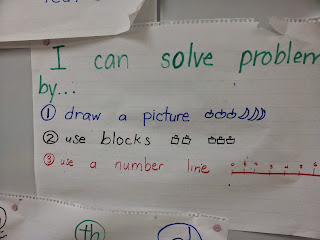
As students explain their reasoning, I begin an anchor chart of
how to solve word problems. The first day you may only have one strategy on the
chart. If you do it every day with a different problem each day, you’ll soon
begin adding more strategies as children implement them.
how to solve word problems. The first day you may only have one strategy on the
chart. If you do it every day with a different problem each day, you’ll soon
begin adding more strategies as children implement them.
If you see there is one strategy you’d like them to use and no one has implemented
it, you can explicitly teach it. For example, students don’t always jump to a
number line to solve a problem (although I’ve seen it done). Often the number
line strategy is one I have to directly teach.
it, you can explicitly teach it. For example, students don’t always jump to a
number line to solve a problem (although I’ve seen it done). Often the number
line strategy is one I have to directly teach.
When you come to the carpet to share, be sure to refer to the anchor chart when
someone has implemented a strategy. This will ensure students will refer to it
tomorrow, when they are solving the next problem. You can let them know this
chart is here to help us, and we can look at it when we’re solving problems to
help us remember problem solving strategies.
someone has implemented a strategy. This will ensure students will refer to it
tomorrow, when they are solving the next problem. You can let them know this
chart is here to help us, and we can look at it when we’re solving problems to
help us remember problem solving strategies.
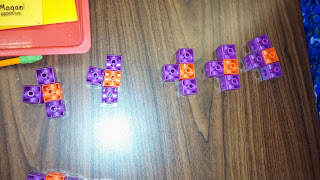
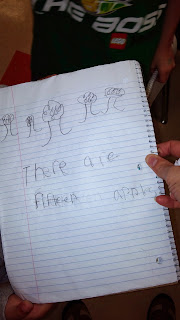
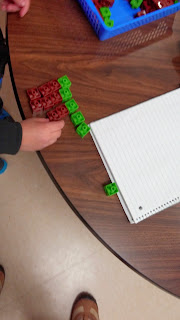
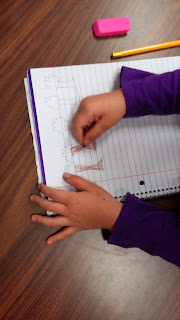
The problem I had given my class was:
There were five trees. Each tree had three apples. How
many apples were there in all?
This is a multiplication problem. Here is how they
solved it. It was interesting to see the way they arranged their blocks. Some
students chose to use blocks, while others drew a picture. The early finishers
re-solved it using another strategy they hadn’t used:
solved it. It was interesting to see the way they arranged their blocks. Some
students chose to use blocks, while others drew a picture. The early finishers
re-solved it using another strategy they hadn’t used:
If you’re ready to get started today, this is it!
Cognitively Guided Instruction has CGI
problems covering all problem types (from joining and separating to
multiplication and division) already written for you. All your preschool, Kindergarten,
or 1st grade students have to do is cut and glue to their notebook before solving.
You can also just write the problems yourself each day as you go.
(Here’s a freebie if you’re not ready to buy just yet.)
Cognitively Guided Instruction has CGI
problems covering all problem types (from joining and separating to
multiplication and division) already written for you. All your preschool, Kindergarten,
or 1st grade students have to do is cut and glue to their notebook before solving.
You can also just write the problems yourself each day as you go.
(Here’s a freebie if you’re not ready to buy just yet.)

Teacherof20 is a stay at home mom, and past K-1st teacher and reading specialist. She enjoys making
clipart for her TpT store and helping other teachers with easy, ready to go products that challenge students!
You can also follow her on facebook for seasonal freebies!


As a CGI Trainer for teachers, teachers are to never teach students strategies! Usually, if we are patient, they will eveNtually move into using other strategies. The number line is still direct modeling . When a student counts on, you might ask how someone couLd prove it in a different way, anD possibly a student will use tHe number line. You will not find the cgi researchers ever suggesting tHat we teach strategies that students don’t use.
Thank you for your comment! I’ve never taught with CGI, so I wasn’t aware of what the typical protocol is. I appreciate you taking the time to let us know what trainers recommend.